
Uncategorized

Essential Features of a Modern Website
Uncategorized

Essential Features of a Modern Website Should Have: Building a High-Performing Digital Presence in 2026

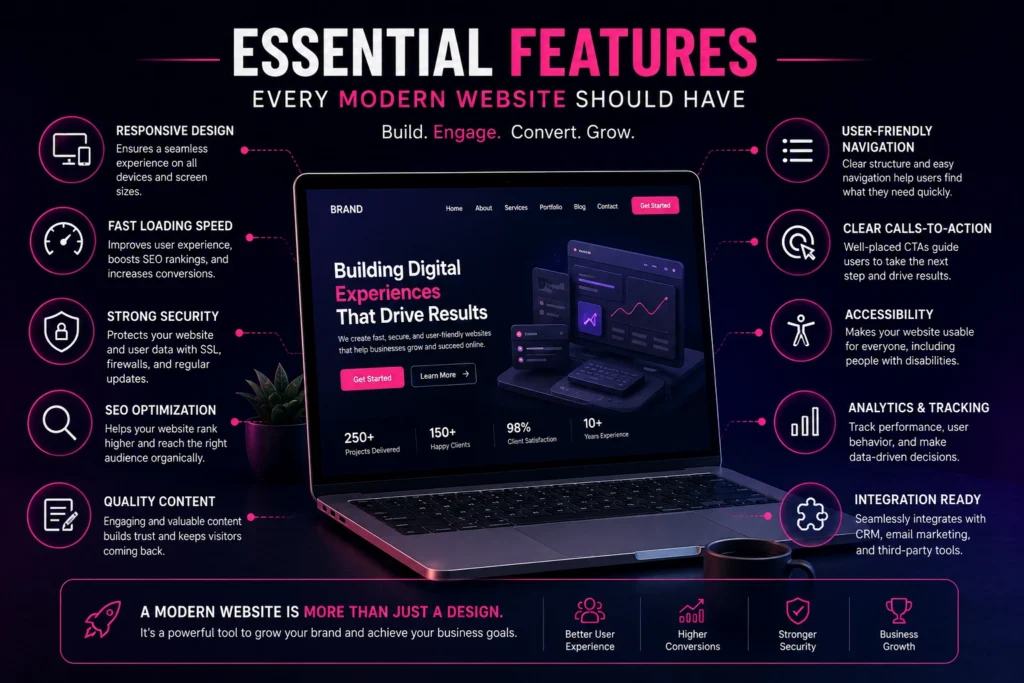
Introduction: Essential Features of a Modern Website Modern websites must do far more than simply display information. They must deliver exceptional user experiences, maintain strong security, support SEO efforts, and drive meaningful business outcomes. Therefore, businesses should prioritize essential features such as responsive web design, fast loading speed, user-friendly navigation, website security, high-quality content, accessibility, analytics, and digital marketing integration. Furthermore, technology and user expectations will continue to evolve in the coming years. Organizations that invest in modern website features today will be better positioned to adapt to future trends and remain competitive. Ultimately, a well-designed website serves as a powerful digital asset that strengthens brand credibility, enhances customer engagement, and supports sustainable business growth in 2026 and beyond.. Responsive Web Design: Creating a Seamless Experience Across Devices:- Responsive web design has become one of the most important features of a modern website. Today, users access websites through smartphones, tablets, laptops, and desktop computers. Therefore, websites must automatically adapt to different screen sizes and resolutions. Furthermore, responsive design enhances user experience by ensuring content remains readable and visually appealing regardless of the device being used. Visitors can navigate effortlessly without zooming or scrolling excessively. Consequently, businesses can reach a wider audience while maintaining consistency across all platforms. Additionally, search engines prioritize mobile-friendly websites in search rankings. As a result, implementing responsive web design not only improves usability but also strengthens SEO performance. Businesses that invest in mobile optimization often experience higher engagement and lower bounce rates. Modern websites must do more than simply look attractive; they must provide a seamless experience across all devices. Responsive web design ensures that users receive consistent functionality, faster accessibility, and improved satisfaction, making it an essential component of every successful website. By embracing responsive design, businesses can strengthen their online presence, improve customer engagement, and stay competitive in an increasingly mobile-driven digital world Fast Loading Speed: Delivering Instant Access to Information:- Website speed plays a critical role in user satisfaction and business success. Modern users expect websites to load within seconds, and even slight delays can lead to frustration. Therefore, optimizing website performance should be a top priority for every business. Moreover, fast-loading websites contribute to improved search engine rankings. Search engines consider page speed as a ranking factor because they aim to provide users with the best possible experience. Consequently, businesses that prioritize website speed gain a competitive advantage in search visibility. In addition, faster websites typically achieve higher conversion rates. Visitors are more likely to stay engaged and complete desired actions when pages load quickly. Therefore, performance optimization directly impacts both user experience and business outcomes. User-Friendly Navigation: Guiding Visitors with Ease:- Effective navigation helps visitors find information quickly and efficiently. Without a clear navigation structure, users may become confused and leave the website. Therefore, intuitive menus and logical site organization are essential components of modern web design. Furthermore, user-friendly navigation improves accessibility and enhances overall engagement. Visitors should be able to locate important pages, products, or services without unnecessary effort. As a result, businesses can encourage longer browsing sessions and increase customer satisfaction. Additionally, streamlined navigation supports conversion goals by guiding users toward desired actions. Whether visitors are making purchases, requesting information, or contacting the company, clear pathways help facilitate those interactions effectively. Strong Website Security: Protecting Users and Business Data:- Cybersecurity has become increasingly important as online threats continue to evolve. Modern websites must prioritize security to protect both business information and customer data. Therefore, implementing robust security measures is essential for maintaining trust and credibility. Moreover, security features such as SSL certificates, secure authentication systems, and regular software updates help safeguard websites against potential attacks. Consequently, businesses can reduce vulnerabilities and minimize risks associated with cyber threats. In addition, secure websites create confidence among visitors. Customers are more likely to share personal information and complete transactions when they trust the platform. Therefore, website security directly influences customer relationships and business reputation. Search Engine Optimization (SEO): Increasing Online Visibility:- A visually attractive website offers limited value if potential customers cannot find it online. Therefore, search engine optimization remains one of the most essential features of a modern website. SEO helps improve visibility in search results and drives organic traffic. Furthermore, modern SEO involves optimizing website structure, content, metadata, and technical performance. Businesses that follow SEO best practices increase their chances of appearing in front of relevant audiences. Consequently, they can attract qualified visitors who are actively searching for their products or services. Additionally, SEO provides long-term value compared to many other marketing strategies. While paid advertising generates immediate traffic, organic search visibility can continue delivering results over time. Therefore, integrating SEO into website development is a smart investment. High-Quality Content: Engaging and Informing Your Audience:- Content remains one of the most powerful tools for building authority and connecting with audiences. Modern websites should provide valuable, relevant, and informative content that addresses user needs and interests. Moreover, high-quality content supports both user engagement and SEO performance. Search engines favor websites that consistently publish useful information. Consequently, businesses can improve rankings while establishing themselves as industry leaders. Additionally, compelling content encourages visitors to spend more time on the website. Blog posts, case studies, guides, and educational resources help build trust and nurture customer relationships. Therefore, content creation should remain a core component of every website strategy. Clear Calls-to-Action (CTAs): Driving User Engagement:- Every modern website should include strategically placed calls-to-action that guide users toward specific objectives. Whether encouraging purchases, newsletter signups, or contact requests, CTAs play a vital role in conversion optimization. Furthermore, effective CTAs use clear and persuasive language that motivates users to take action. Buttons such as “Get Started,” “Contact Us,” or “Request a Quote” help direct visitors toward meaningful interactions. Consequently, businesses can increase lead generation and customer acquisition. In addition, well-designed CTAs improve user journeys by reducing confusion and providing direction. Visitors understand exactly what steps to take next, resulting in smoother and more efficient experiences. Accessibility Features: Making Websites Inclusive for Everyone:- Website accessibility ensures that
WordPress vs Custom Development
Uncategorized

WordPress vs Custom Development: Which Solution Will Drive Your Business Growth in 2026?

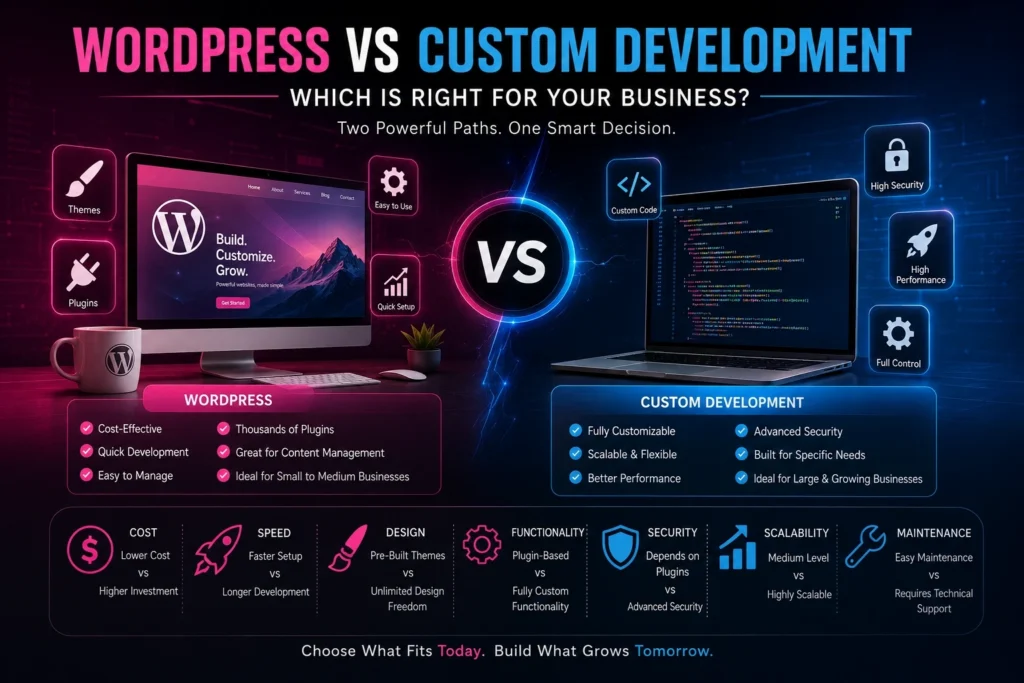
Introduction: Choosing the Right Foundation for Your Business Website:- In 2026, your website is more than just an online brochure—it’s the foundation of your digital presence. Whether you’re a startup, a small business, or an established brand, a well-designed website can help you attract visitors, generate leads, and convert customers. With user expectations and search engine algorithms evolving rapidly, businesses need websites that are fast, secure, mobile-friendly, and optimized for search engines. In this article, we’ll explore the essential features every modern website should have to build a high-performing digital presence and support long-term business growth. Understanding WordPress vs Custom Development:- In today’s digital world, a professional website is one of the most valuable assets for any business. Whether you’re launching a startup, expanding an established company, or building an eCommerce store, choosing the right website development approach is a crucial decision. Two of the most popular options are WordPress and Custom WordPress is an excellent choice for businesses that need a professional website within a limited budget and timeframe. From corporate websites and portfolios to blogs and small eCommerce stores, WordPress offers a flexible and user-friendly platform. What Is Custom Website Development?:- Custom website development involves building a website from the ground up based on specific business requirements. Unlike WordPress, which relies on pre-built themes and plugins, custom development enables developers to create unique designs and functionalities tailored to an organization’s goals. Moreover, custom websites provide complete control over every aspect of the development process. Businesses can implement specialized features, optimize performance, and create highly personalized user experiences. Consequently, custom development is often preferred by organizations with complex requirements or long-term scalability objectives. Comparing Development Costs:- Cost is often one of the first factors businesses consider when choosing between WordPress and custom development. Generally, WordPress websites require lower initial investments because developers can leverage existing themes, plugins, and frameworks to accelerate the development process. On the other hand, custom website development typically involves higher upfront costs due to the extensive planning, design, coding, and testing required. However, businesses should also consider long-term expenses. While WordPress may appear more affordable initially, ongoing plugin subscriptions, maintenance, and customization costs can accumulate over time. Therefore, evaluating both short-term and long-term costs is essential. Design Flexibility and Brand Identity:- Creating a unique brand identity is crucial in today’s competitive market. WordPress offers numerous design templates that allow businesses to build visually appealing websites quickly. Additionally, premium themes provide advanced customization options that can help brands stand out. However, custom development offers unparalleled design freedom. Developers can create completely original interfaces tailored specifically to the brand’s vision and customer expectations. Consequently, businesses seeking a distinctive digital presence often benefit from the flexibility that custom development provides. This advantage becomes particularly important for companies operating in highly competitive industries Website Performance and Speed:- Website performance plays a critical role in user experience and search engine rankings. A fast-loading website improves visitor satisfaction and increases the likelihood of conversions. Therefore, performance should be a major consideration when selecting a development approach. WordPress websites can achieve excellent performance when properly optimized. Nevertheless, excessive plugins, poorly coded themes, and inadequate hosting can negatively impact loading speeds. In contrast, custom-developed websites can be optimized specifically for performance from the beginning. As a result, custom solutions often provide greater efficiency and faster response times, especially for complex applications. SEO Capabilities and Search Visibility:- Search engine optimization (SEO) is essential for increasing online visibility and attracting potential customers. Fortunately, both WordPress and custom websites can support effective SEO strategies when implemented correctly. WordPress offers numerous SEO plugins that simplify technical optimization tasks such as metadata management, sitemap generation, and content analysis. Consequently, businesses can improve search performance without extensive technical expertise. Meanwhile, custom websites allow developers to build SEO-friendly structures from the ground up, providing greater control over technical optimization. Therefore, both options can deliver strong SEO results depending on implementation quality. Security Considerations for Modern Websites:- Website security has become increasingly important as cyber threats continue to evolve. Businesses must protect customer information, maintain trust, and prevent unauthorized access to sensitive data. WordPress websites can be highly secure when maintained properly. Regular updates, secure hosting environments, and trusted plugins significantly reduce vulnerabilities. However, because WordPress powers a large percentage of websites worldwide, it remains a common target for attackers. Conversely, custom-developed websites can implement tailored security measures designed specifically for business requirements. As a result, organizations with stringent security needs may prefer custom development solutions Scalability and Future Growth:- As businesses grow, their websites must adapt to increasing traffic, evolving customer expectations, and expanding functionality requirements. Therefore, scalability should be considered during the initial development phase. WordPress can support significant growth when combined with high-quality hosting and optimization strategies. Many successful businesses operate large-scale WordPress websites with impressive performance. Nevertheless, highly complex systems may eventually encounter limitations due to plugin dependencies and architectural constraints. Custom development, however, provides virtually unlimited scalability. Developers can design systems specifically to accommodate future growth and evolving business needs. Consequently, organizations with ambitious expansion plans often choose custom development as a long-term investment Maintenance and Ongoing Management:- Every website requires regular maintenance to ensure optimal performance, security, and functionality. Understanding maintenance requirements can help businesses estimate ongoing resource commitments. WordPress websites generally require frequent updates for themes, plugins, and the core platform. Although these updates are relatively straightforward, they must be managed carefully to avoid compatibility issues. Additionally, plugin conflicts can occasionally create unexpected challenges. Custom websites also require maintenance; however, updates are typically tailored to the specific application. While custom maintenance may require specialized developer support, it often eliminates the dependency on multiple third-party plugins. Therefore, maintenance strategies differ significantly between the two approaches. Which Option Is Best for Small Businesses?:- Small businesses often prioritize affordability, speed, and ease of management. In many cases, WordPress provides an ideal solution because it enables organizations to launch professional websites quickly without significant financial investment. Furthermore, WordPress offers flexibility for content updates and marketing initiatives. Business

Artificial Intelligence in Web Development
Uncategorized

How AI Is Transforming Website Development in 2026: The Future of Smarter, Faster, and More Intelligent Websites

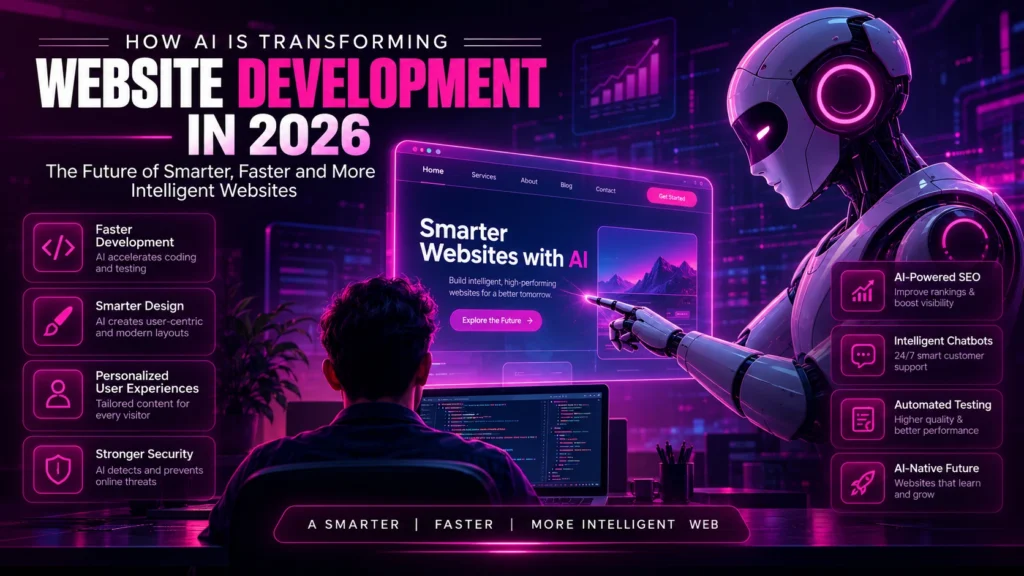
ntroduction: A New Era of Website Development:- Artificial Intelligence (AI) is reshaping the digital landscape at an unprecedented pace. In 2026, AI is no longer a supplementary technology used for simple automation. Instead, it has become an essential component of modern website development, influencing everything from design and coding to user experience and website maintenance. Businesses that embrace AI-powered development are gaining a significant competitive advantage by delivering faster, smarter, and more personalized online experiences. Artificial Intelligence in Web Development is revolutionizing how websites are planned, designed, and managed. AI-powered tools help developers automate coding tasks, improve website performance, enhance security, and create personalized user experiences. By analyzing user behavior and preferences, AI enables businesses to deliver smarter, faster, and more engaging websites that meet the evolving demands of modern digital audiences AI-Powered Development Is Accelerating Project Delivery:- One of the most significant impacts of AI in website development is the acceleration of development workflows. Today, AI-powered tools can generate code, identify bugs, suggest improvements, and automate testing processes. Consequently, developers can build websites more quickly while maintaining high-quality standards. Furthermore, AI enables developers to streamline complex coding tasks that previously required extensive manual effort. By reducing repetitive work, teams can allocate more time to strategic planning and feature development. Therefore, businesses can launch websites faster and respond more effectively to changing market demands. Intelligent Web Design Is Revolutionizing User Experiences:- AI is transforming web design by helping designers create visually appealing and user-centric websites. Modern AI tools can analyze user behavior, design trends, and engagement metrics to recommend optimal layouts, color schemes, and navigation structures. As a result, websites become more intuitive and engaging. Additionally, AI-driven design platforms can generate website mockups within minutes. This capability allows designers to experiment with multiple concepts quickly and efficiently. Consequently, businesses can create professional and conversion-focused websites without lengthy design cycles. Personalized Experiences Are Becoming the New Standard:- Website visitors increasingly expect personalized experiences, and AI is making this possible on a large scale. By analyzing user behavior, browsing history, preferences, and interaction patterns, AI can deliver customized content tailored to individual users. Moreover, AI-powered personalization improves engagement, increases customer satisfaction, and boosts conversion rates. Instead of presenting the same content to every visitor, websites can dynamically adapt to each user’s interests. Consequently, businesses can strengthen customer relationships and achieve better marketing outcomes. AI Chatbots and Virtual Assistants Are Enhancing Customer Support:- Customer service has undergone a remarkable transformation due to AI-powered chatbots and virtual assistants. Modern chatbots can answer customer inquiries, provide recommendations, schedule appointments, and guide users through complex processes around the clock. In addition, these intelligent systems continuously learn from interactions and improve their responses over time. As a result, businesses can provide faster support while reducing operational costs. Furthermore, customers benefit from immediate assistance, leading to improved satisfaction and trust. AI Is Transforming SEO and Search Visibility:- Search engine optimization is evolving rapidly, and AI is playing a central role in this transformation. In 2026, websites must optimize not only for traditional search engines but also for AI-powered search platforms and answer engines. This shift has introduced new concepts such as Answer Engine Optimization (AEO) and Generative Engine Optimization (GEO). Furthermore, AI tools can analyze search intent, identify keyword opportunities, optimize content structures, and recommend improvements for better visibility. Consequently, businesses can increase their online presence and attract more qualified traffic. As AI-driven search continues to grow, adapting website content for AI discovery will become increasingly important. Automated Testing and Quality Assurance Are Improving Reliability:- Website quality remains a critical factor in digital success. Fortunately, AI is helping developers identify issues before they affect users. AI-powered testing tools can automatically detect bugs, performance bottlenecks, and security vulnerabilities throughout the development lifecycle. Additionally, automated testing reduces the risk of human error and accelerates deployment processes. As a result, websites can maintain higher performance standards while minimizing downtime. Businesses benefit from improved reliability, and users enjoy smoother digital experiences. Enhanced Security Through AI-Driven Protection:- Cybersecurity threats continue to evolve, making website protection more important than ever. AI is helping organizations strengthen their security posture by identifying suspicious activities, detecting anomalies, and responding to threats in real time. Moreover, AI-powered security systems can continuously monitor website activity and predict potential vulnerabilities before attackers exploit them. Therefore, businesses can protect sensitive customer data while maintaining user trust. As cyber threats become increasingly sophisticated, AI-driven security will remain a vital component of website development. AI Is Empowering Developers Rather Than Replacing Them:- Many professionals worry that AI will replace web developers. However, the reality is quite different. AI serves as a powerful assistant that enhances productivity and automates repetitive tasks, allowing developers to focus on higher-level problem-solving and innovation. Furthermore, successful website development still requires human creativity, strategic thinking, user empathy, and business understanding. While AI can generate code and automate workflows, developers remain essential for making critical decisions and ensuring project success. Therefore, AI is best viewed as a collaborative partner rather than a replacement. The Rise of AI-Native Websites and Future Innovations:- The next generation of websites will be AI-native, meaning AI will be deeply integrated into every aspect of their functionality. These websites will continuously learn from user interactions, adapt content dynamically, and optimize performance automatically. Consequently, businesses will be able to deliver more intelligent and responsive digital experiences. In addition, emerging technologies such as autonomous AI agents, predictive analytics, voice interfaces, and intelligent automation will further redefine the web development landscape. As these innovations mature, organizations that embrace AI early will be better positioned for long-term growth and digital success. Conclusion: Embracing the AI-Powered Future of Web Development:- Artificial Intelligence is fundamentally transforming website development in 2026. From automated coding and intelligent design to personalized experiences, enhanced security, and AI-driven SEO, the technology is revolutionizing how websites are built and managed. Businesses that leverage AI effectively can improve efficiency, reduce costs, and deliver superior digital experiences. As technology continues to evolve, AI will become even more integrated into

Scroll to Top